11 October 2026
Case Study
Overview
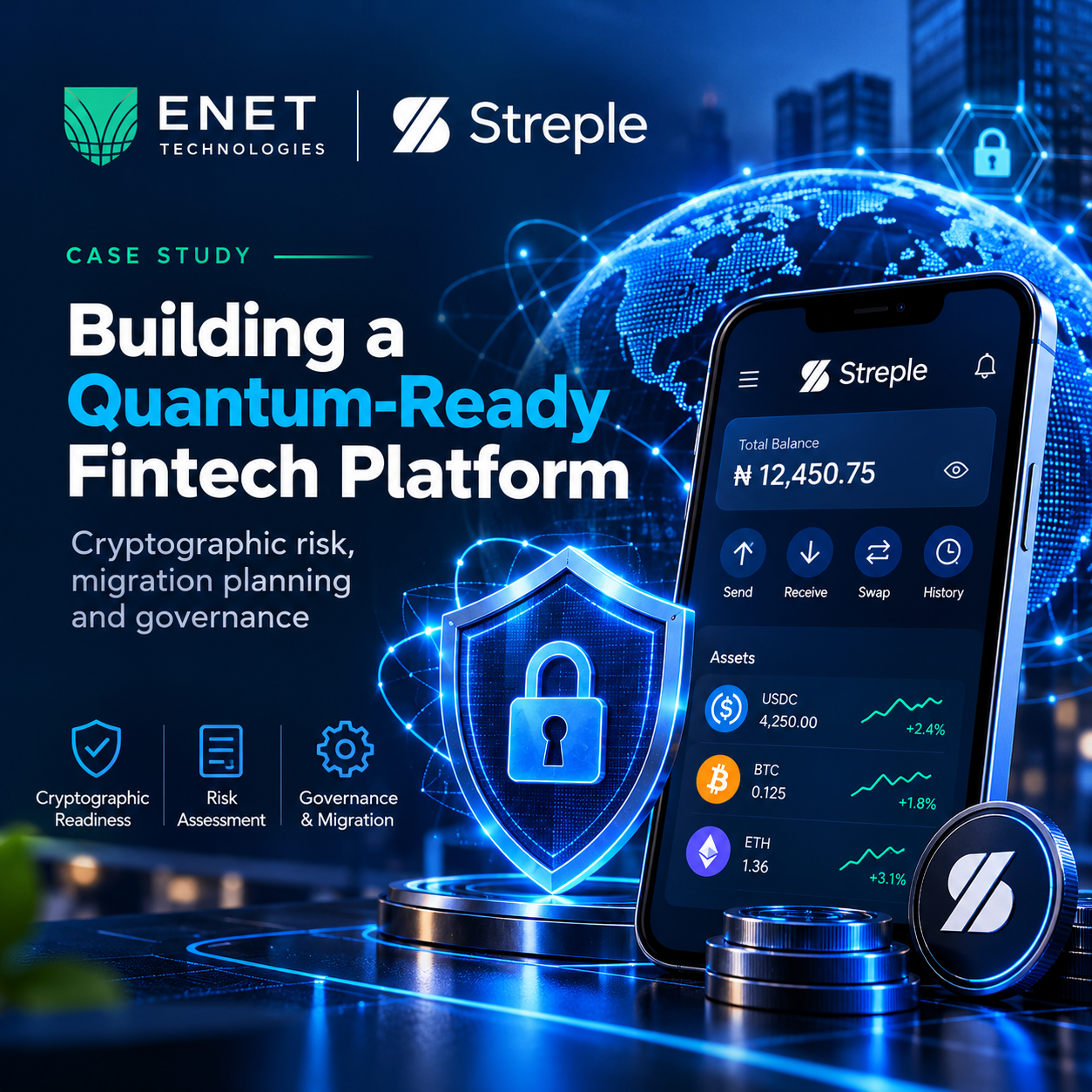
At Enet Technologies, our post-quantum cryptography work has led us to a central conclusion: preparing for quantum-era security is not simply an algorithm replacement exercise. It is an enterprise visibility, risk management and governance challenge.
This perspective informs our work on Streple, our fintech project, and our wider research into post-quantum cryptography (PQC) migration.
Digital finance platforms depend on cryptographic mechanisms to protect communications, authenticate services, establish trust and secure sensitive information. As the cryptographic landscape evolves, organisations need to understand which mechanisms they use, where those mechanisms are embedded and how changes could affect their systems and business operations.
Our objective is to make post-quantum readiness a structured planning activity rather than a last-minute response to a future technology shift.
The challenge
The threat commonly described as "harvest now, decrypt later" creates a reason to assess cryptographic exposure before large-scale quantum computers capable of breaking widely used public-key cryptography become available.
An adversary may collect encrypted information today with the intention of decrypting it in the future. The implications depend on the information's sensitivity, the length of time it must remain confidential and the cryptographic mechanisms protecting it.
For a fintech project such as Streple, the wider planning questions include the security of communications, application and infrastructure dependencies, cryptographic libraries, certificates, third-party services and the ability to change cryptographic mechanisms without extensive redesign.
The challenge is compounded by a visibility problem: organisations cannot make well-founded migration decisions when they do not know where cryptography is used or which business processes depend on it.
What our research taught us
Our post-quantum migration research and research-note work have explored several principles that shape our approach.
1. You cannot migrate what you cannot see
A migration programme requires a sufficiently reliable understanding of cryptographic assets and dependencies.
This includes identifying relevant algorithms, protocols, certificates, libraries, applications and external dependencies. It also requires distinguishing verified inventory findings from assumptions and unknowns.
For Streple, this principle informs the need to treat cryptographic discovery and dependency mapping as foundational planning activities before deciding which components should be migrated first.
2. Data stolen today may be decrypted tomorrow
The harvest-now, decrypt-later threat means that future cryptographic risk must be considered alongside the sensitivity and useful lifetime of protected information.
Risk prioritisation should account for the potential impact of future exposure, the business criticality of affected systems, the lifetime of the data and the practical time required to change cryptographic dependencies.
This provides a more useful basis for prioritisation than treating every cryptographic component as equally urgent.
3. Governance may be the missing piece
Cryptographic migration affects more than engineering teams. It can involve product owners, security architects, infrastructure teams, procurement, compliance, business leadership and third-party suppliers.
Our research emphasises the need for clear decision rights, risk ownership, accountable remediation, supplier engagement and management oversight.
Without these elements, technical findings may never translate into funded and coordinated action.
4. Migration requires a decision framework
A practical readiness approach must turn discovery and risk assessment into a defensible sequence of actions.
For Streple, the planning model considers how systems might be prioritised according to cryptographic exposure, data sensitivity, operational criticality, dependency complexity, supplier readiness and migration effort.
The resulting decisions should be documented so that stakeholders can understand why a particular dependency receives attention before another.
5. Cryptographic agility matters
A resilient architecture should make future cryptographic changes easier to manage.
Cryptographic agility involves designing systems and processes so that cryptographic mechanisms can be updated or replaced without unnecessary redesign. It must be balanced with interoperability, performance, implementation security and appropriate standards guidance.
For a digital finance platform, this is an architectural consideration that should be evaluated against the actual system design and deployment requirements.
Our approach to Streple readiness
We use these research principles to structure the post-quantum planning questions surrounding Streple.
The approach focuses on:
Establishing visibility into cryptographic dependencies within the assessed scope.
Identifying unknowns that require further technical discovery.
Prioritising risks according to data sensitivity, business impact and migration complexity.
Considering applicable NIST post-quantum cryptography standards and relevant interoperability requirements.
Defining governance, ownership and supplier dependencies.
Developing a phased migration strategy that accounts for testing, operational continuity and future cryptographic agility.
NIST's post-quantum standards provide important reference points, including FIPS 203 for ML-KEM, FIPS 204 for ML-DSA and FIPS 205 for SLH-DSA. Their applicability must be assessed in context; a standards reference does not establish that a system has implemented or been certified against those standards.
What this work demonstrates
Our Streple-related PQC planning and research demonstrate the importance of connecting emerging cryptographic threats with practical enterprise decision-making.
The work establishes a direction for:
Understanding cryptographic exposure before migration.
Connecting data sensitivity with long-term confidentiality risk.
Prioritising dependencies according to business impact.
Incorporating standards alignment into architecture and planning.
Making migration responsibilities visible to decision-makers.
Establishing measurable readiness indicators for future programme oversight.
The distinction is important: a readiness strategy and migration roadmap are not the same as a completed migration. Actual cryptographic inventory coverage, testing, implementation and validation must be established through technical evidence.
Our perspective
We believe organisations should prepare for the post-quantum transition through visibility, governance and risk-informed planning—not fear or premature algorithm replacement.
Our research on Streple and our broader PQC work reinforce the need to treat cryptographic resilience as a continuing enterprise responsibility.
The question is not only whether an organisation understands the quantum threat. It is whether it can identify its dependencies, determine its priorities, coordinate the required decisions and demonstrate progress.
The quantum transition begins with visibility. Resilience requires governance. Migration requires a plan.
Enet Technologies is developing a governance-led approach to post-quantum readiness that connects cryptographic discovery, risk assessment, enterprise architecture and migration planning.
Challenge
Cryptographic dependencies may be difficult to identify across financial technology systems, creating uncertainty about long-term confidentiality risk and migration priorities.
Solution
Apply research-led PQC readiness principles to Streple planning: cryptographic discovery, risk prioritisation, standards alignment, governance and phased migration planning.
Results
Document the research outputs, readiness framework, risk criteria, roadmap and prototype capabilities actually completed.
Technologies
Post-quantum cryptography, cryptographic asset discovery, TLS and certificate assessment, risk analysis, enterprise architecture and cryptographic agility.
Compliance outcomes
Document relevant NIST PQC standards alignment and governance requirements. State which standards were reviewed and which implementation or assurance activities were completed.
Security outcomes
Risk-informed cryptographic planning, prioritisation criteria and identified discovery requirements. Include actual inventory findings, technical validation or completed remediation only where evidence exists.