11 October 2026
Case Study
Overview
At Enet Technologies, we look beyond the technology itself to understand how it can solve practical business problems.
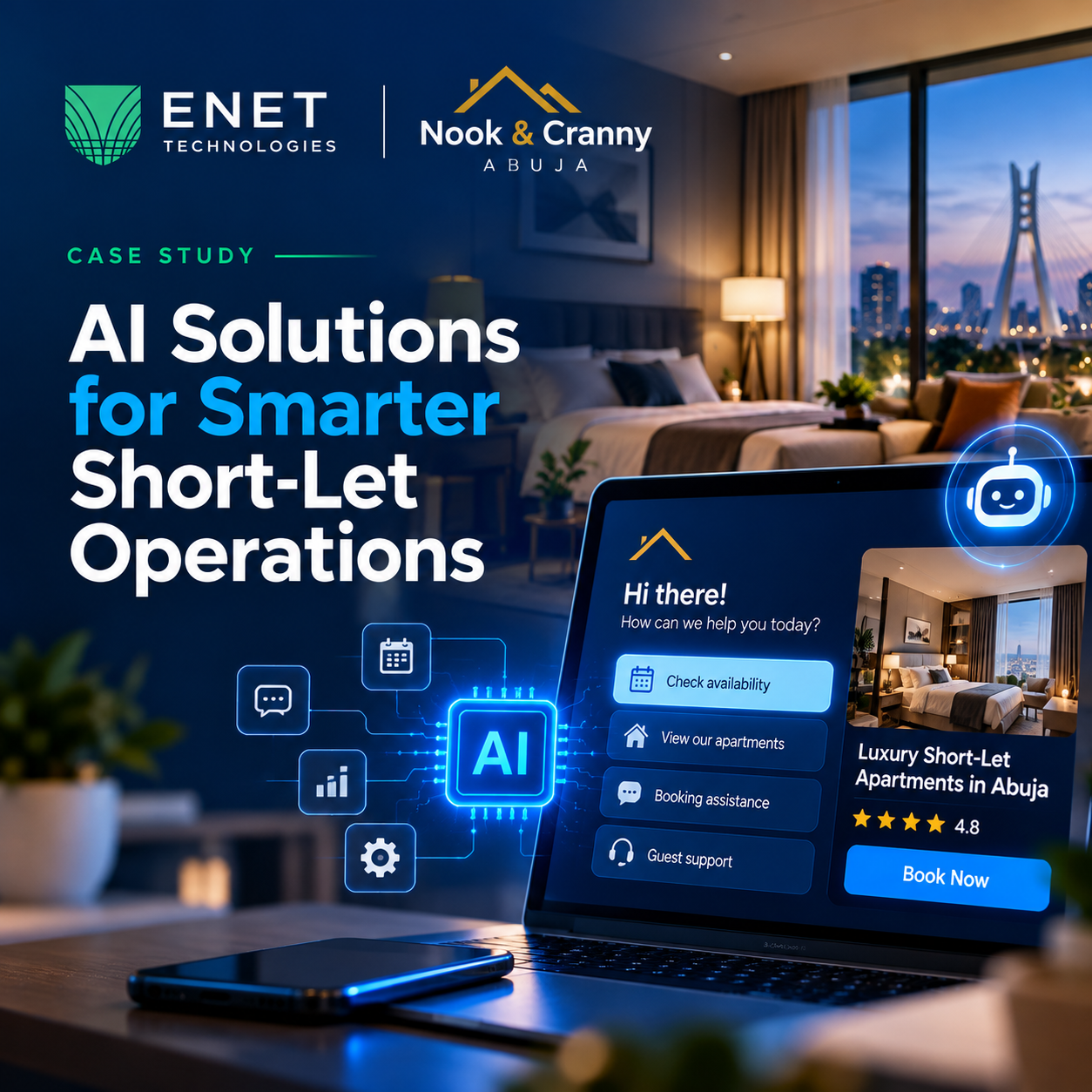
Our work with Nook and Cranny Abuja Shortlet explores the application of artificial intelligence to hospitality operations, where guest experience, responsiveness, booking coordination and efficient property management all influence business performance.
Short-let operators must manage enquiries, availability questions, check-in information, guest requests and service coordination while maintaining a consistent standard of hospitality. When these activities depend heavily on manual responses and fragmented processes, staff can spend valuable time answering repetitive questions instead of focusing on higher-value guest and operational needs.
Our objective was to apply AI in a way that supports service delivery, reduces avoidable administrative work and helps the business use technology more effectively.
The business challenge
Hospitality businesses operate in a service environment where responsiveness matters.
Potential guests may ask similar questions about accommodation features, availability, check-in procedures, location, amenities, house rules and booking arrangements. Existing guests may also need assistance during their stay.
When enquiry handling and routine coordination are largely manual, teams can face repetitive workloads, inconsistent responses and delays during busy periods.
Management also needs to coordinate property readiness, guest communications and service requests while maintaining oversight of the information shared with guests.
The opportunity was to identify where AI could assist these workflows without removing human judgement from decisions that require discretion, exception handling or operational accountability.
Our approach
1. AI-assisted guest enquiries
We considered the role of AI in supporting routine guest communication and providing consistent responses to common questions.
A well-designed hospitality assistant can use approved property information to help answer questions about amenities, check-in instructions, house rules and other frequently requested details.
Where deployed, such an assistant should be configured to recognise its limitations, avoid inventing property information and escalate uncertain or sensitive enquiries to the appropriate staff member.
2. Booking and enquiry workflow support
AI can help organise incoming enquiries, identify the information a prospective guest needs and support the process of moving from an initial question to a confirmed booking.
The important distinction is between providing assistance and making authoritative booking decisions. Availability, pricing, payment confirmation and reservation status should be checked against the relevant source system before being communicated as confirmed.
This approach allows automation to support the booking journey while preserving reliable operational controls.
3. Guest service coordination
AI-assisted workflows can help classify guest requests, identify recurring issues and route service needs to the appropriate person.
For example, a request concerning access, housekeeping or a maintenance issue can be categorised and escalated according to the property's operating procedures.
This can improve consistency in handling requests, provided that assignments, response times and resolution status remain visible to the team.
4. Operational insights and cost awareness
Hospitality operators generate information through enquiries, reservations, guest feedback, service requests and property operations.
When this information is collected and handled appropriately, AI-assisted analysis can help management identify frequently asked questions, recurring service issues and opportunities to improve processes.
The commercial objective is not to automate everything. It is to reduce unnecessary manual effort, direct staff attention towards higher-value work and identify opportunities for more efficient operations.
Any claim about reduced operating costs, improved occupancy or increased bookings should be based on measured results rather than assumed benefits.
5. Privacy, security and human oversight
AI adoption must account for the sensitive information that can arise during booking and guest communication.
Our approach recognises the importance of limiting access to guest information, using appropriate authentication, controlling data retention, reviewing third-party AI services and ensuring that personal information is handled in accordance with applicable requirements.
Human review remains important for complaints, unusual requests, payment disputes, sensitive guest information and decisions that materially affect a reservation or customer.
Business value
The application of AI to short-let operations can create value when it addresses real workflow bottlenecks.
The intended benefits include:
More consistent handling of routine guest enquiries.
Reduced repetitive administrative work where tasks can be safely automated.
Better organisation and routing of guest service requests.
Improved visibility into recurring operational issues.
More efficient use of staff time.
A more structured approach to privacy, access control and human oversight.
The actual impact depends on the workflows implemented, the quality of the underlying information, staff adoption and the ability to measure performance before and after deployment.
Our perspective
We believe AI delivers the greatest business value when it is designed around a real operational need rather than introduced simply because the technology is available.
Hospitality businesses are a strong example. Many important tasks are repetitive enough to benefit from automation, but the guest experience still depends on empathy, judgement and reliable human support.
At Enet Technologies, we combine technology consulting with security-conscious implementation thinking to help businesses explore AI in a practical and responsible way.
Smarter operations. More responsive hospitality. AI with a business purpose.
Enet Technologies helps organisations identify useful AI opportunities, design appropriate workflows and consider the security, privacy and operational controls required for responsible adoption.
Challenge
Manual or repetitive hospitality workflows can create avoidable administrative effort, inconsistent guest communications and delays in service coordination.
Solution
AI deployment and consulting focused on hospitality workflows. Specify the actual assistant, integrations, automation and management tools deployed.
Results
Record the workflows deployed, tasks automated, staff feedback and measured changes in response times or administrative effort where available.
Technologies
AI assistant, workflow automation, approved knowledge sources and business-system integrations, where actually used.
Compliance outcomes
Documented privacy and data-handling considerations, access responsibilities and relevant operational safeguards. Do not claim formal compliance certification.
Security outcomes
Describe implemented access restrictions, information-handling controls, escalation rules and human oversight. Retain only controls verified in the deployment.